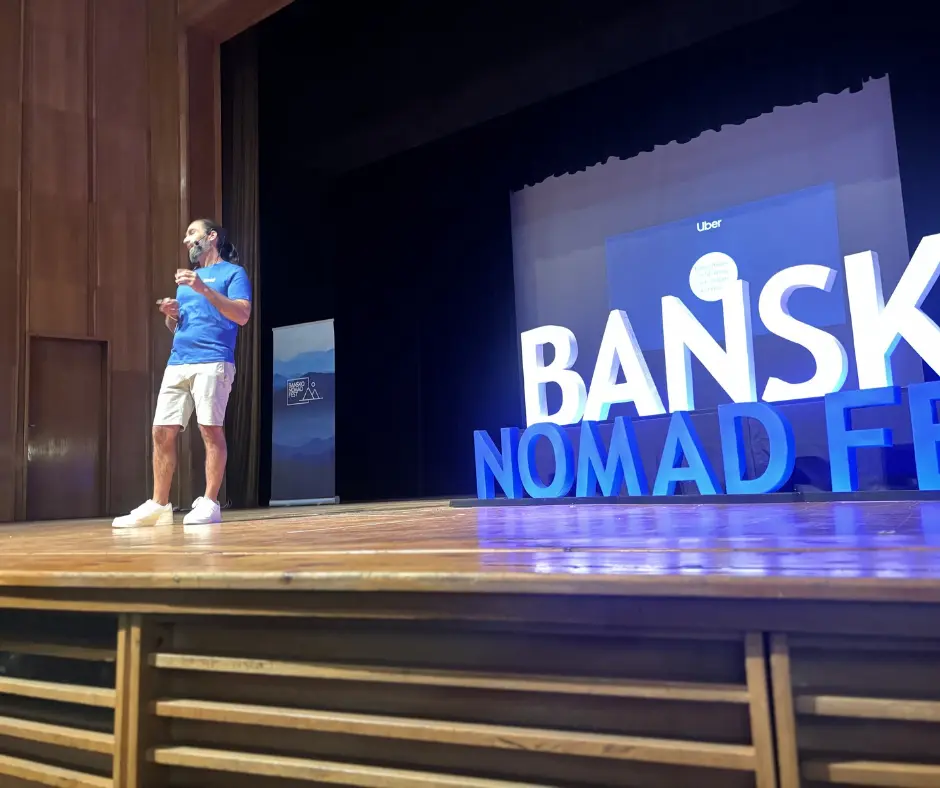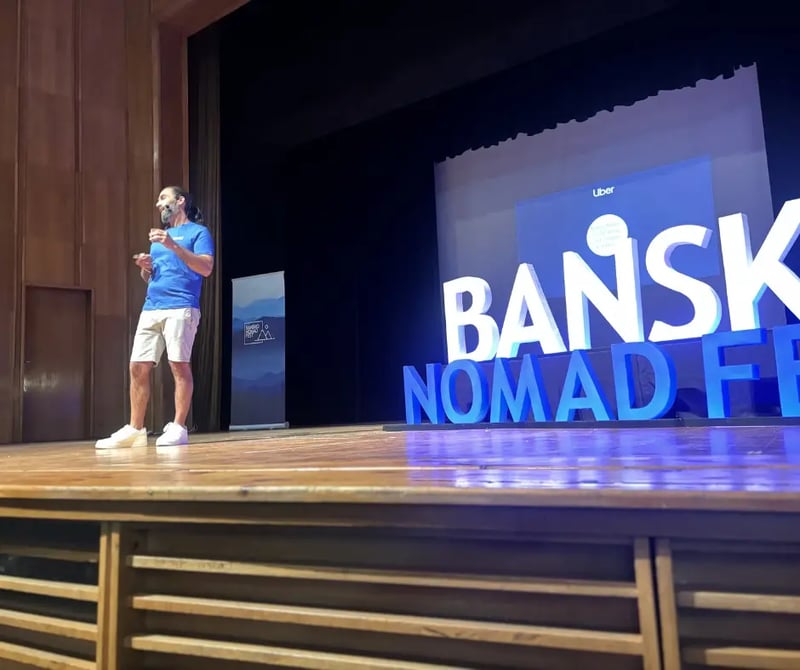

Every June, a small ski town in the Pirin mountains turns into the biggest gathering in the nomad world. Bansko Nomad Fest fills the old town with talks, park sessions, hikes, a hot springs pool party and a bonfire in the woods, and by the end of the week it genuinely feels like a village where you know everyone. If you are thinking about going in 2027, now is the time to decide, because the fest runs on early-bird pricing and the cheapest tickets go first.
This guide covers what is confirmed for 2027 so far, how the tickets work, what a week really costs, how to get there and where to stay, and the part that matters most: what to expect as a first-timer and how to get through the week without burning out by Wednesday.
🌱 Travel health insurance for nomads
Summary
- 🌱 Travel health insurance for nomads
- 🎯 Bansko Nomad Fest 2027 at a glance
- 🏔️ What Bansko Nomad Fest actually is
- 📣 What is confirmed for 2027, and what is not
- 🎟️ Tickets and the early-bird math
- 💶 What a week really costs
- ✈️ How to get to Bansko
- 🏡 Where to stay
- 🌤 What June in Bansko is like
- 📅 What to expect as a first-timer
- 🛂 Schengen, money and other practicalities
- 🌍 What to do in Bansko beyond the fest
- ❓ Frequently asked questions
- 🎉 See you in Bansko
🎯 Bansko Nomad Fest 2027 at a glance
| 📅 Dates | Sunday, June 20 to Sunday, June 27, 2027, with Industry Day just before |
| 📍 Place | Bansko, Bulgaria, about 2.5 to 3 hours from Sofia |
| 🎟 Tickets | Standard (full week) and Social (Friday and Saturday program) on sale now. The organizer also lists Silver and Industry tickets |
| 💶 Price guide | As of November 6, 2026: Standard €225, Social €125, both including VAT. Prices rise as tiers sell |
| 🎤 Program | 2027 lineup not announced yet. Speakers usually land in spring |
| 🗣 Format | Festival with a conference core: talks on two stages, unconferences, wellness, evening events |
| 👥 Who it is for | Remote workers and nomads at every stage, including people only thinking about it. Coming solo is normal |
| 🛂 Schengen | Bulgaria is a full Schengen member: days in Bansko count toward your 90/180 |
Dates checked against the organizer's site on November 4, 2026, ticket prices on November 6, 2026.
🏔️ What Bansko Nomad Fest actually is
Bansko Nomad Fest (BNF) is the largest annual meetup of digital nomads, remote workers and location-independent entrepreneurs. It started in 2020 with around 50 people in a coworking space and a town square, and the organizer now bills it as a gathering of 1,000+ people from 50+ countries. The 2027 edition is the eighth.
It is not a classic conference. There is a conference core, with 50+ speakers on two stages in past editions covering entrepreneurship, AI, global mobility, remote work and money, but the stage program is only part of the week. Around it sit community-led unconference sessions in the park, a morning wellness program, activities in the mountains and an evening lineup that runs from speed dating and karaoke to the pool party and bonfire night. Think of it as a festival with talks rather than a conference with a party.
One change for 2027: the official dates run Sunday to Sunday, eight days, where the 2026 edition ran ten days from June 20 to 30. Industry Day, the B2B day for companies and organizers in the nomad economy, takes place just before the main week.
"I felt right at home, even thousands of kilometres away from my birthplace, with people I've just met and whom I 'only' shared one week." BNF attendee
The festival is organized from Bansko by the team behind Coworking Bansko, the town's original nomad coworking space. Genki partnered with the 2026 edition as its health partner.
📣 What is confirmed for 2027, and what is not
- Confirmed: the dates (June 20 to 27, 2027), the location, the ticket types, and early-bird sales, which are open now.
- Indicative: prices for the paid add-ons. The organizer lists the pool party and hot springs at about €40, bonfire night at about €15 and a spa day at about €60, to be finalized closer to the event.
- Not announced yet: the speakers and the program. Speaker applications are open, and in past years the first wave of speakers was announced in spring, around three months before the fest. Anything you read about specific 2027 talks before then is guesswork.
🎟️ Tickets and the early-bird math
Tickets are sold only online, through the festival's ticket shop. There are no tickets at the door.
| Ticket | What you get |
|---|---|
| Standard | The full week: all conference and unconference days, the morning wellness program and the evening Park program, plus the option to host an unconference session. Paid add-ons are booked separately. |
| Social | The conference and unconference program on Friday and Saturday only, plus the morning wellness and evening Park program during the week. Made for people short on time or mostly there for the social side. |
| Silver | Standard access plus the most popular premium activities bundled in, such as the pool party and bonfire night. |
| Industry | For companies and founders who want to network and promote their business, with premium extras. |
Why buying now is the real advice: the organizer's model is simple. Prices rise in steps as the festival gets closer, and the organizer has said it expects to sell out earlier than in previous years. As of November 6, 2026, the ticket shop sells the Standard ticket at €225 and the Social ticket at €125, both including 20% VAT. In recent cycles the cheapest tier, the super early bird, ended on November 30, and for the 2026 edition it cost €195 for Standard, so 2027 already opens higher. A few cycles back, the regular Standard ticket started at €295, so buying early still saves a meaningful amount on the same week.
Today's 2027 prices are on the official ticket page, which always shows the tier currently on sale. Two things to know before you pay: 2027 tickets are non-refundable, but if you cannot come, the price can be converted to app credit, which you can use for a future event or transfer to another person. And if the fest cannot go ahead, your ticket moves to the rescheduled or next edition.
💶 What a week really costs
| One week, solo | Budget (buy early) | Comfortable (buy late) |
|---|---|---|
| Ticket (Standard) | €225 | €295+ |
| Accommodation, 7 nights | €170–250 | €300–500 |
| Paid add-ons | €15–55 | €115 |
| Food and drinks | €120–150 | €200–250 |
| Sofia transfer, return | €25–30 (bus) | €80–130 (shared car) |
| Realistic total | €555–710 | €990–1,290 |
The budget column uses today's Standard price. The late-buyer figure is an estimate based on past regular prices, since later 2027 tiers are not published yet. The biggest swing is accommodation: book early and stay in a simple hotel or guesthouse, and the week stays cheap by any European standard. Book late and you pay for what is left. Bulgaria uses the euro since January 2026, so every price here is what you pay locally.
 Sarah Kuhlemann
✈️ How to get to Bansko
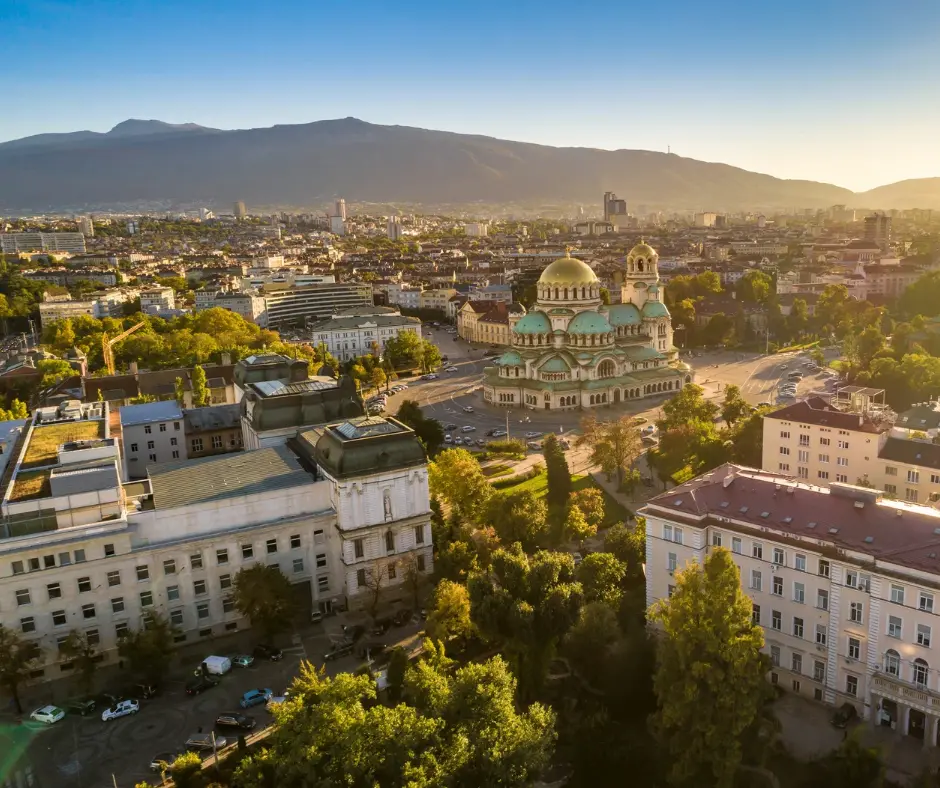
Most people fly into Sofia (SOF). From there, Bansko is about 150 to 170 km by road.
- Bus: the cheapest option at around €10 to €15 one way. Buses leave from Sofia Central Bus Station and take about three hours. From the airport, take the metro from Terminal 2 to the Central Railway Station stop, which sits next to the bus station.
- Shared shuttle: door to door from Sofia Airport, booked in advance, usually around €25 to €45 per person depending on operator and timing.
- Private transfer: about €75 to €130 per car one way, depending on the operator and car size, which is good value split between three or four people. Some operators add an airport pickup fee of around €10. The ride takes about 2.5 hours.
- Rental car: worth it if you want to explore afterwards. The hot springs in Banya, trailheads in Pirin National Park and Rila Monastery are all within reach.
Tip: the organizer runs a festival Telegram group where attendees share rides and the team posts recommended drivers closer to the date. It is also the easiest way to meet people before you arrive. Try to reach Bansko in daylight on your first day: checking in, walking the old town once and easing into the social flow makes the first morning far less overwhelming.
🏡 Where to stay
Accommodation is not included in the ticket, and the town fills up for fest week, so book as soon as you have your ticket. The organizer's own advice is to sort flights, accommodation and transfers right after buying, before prices rise.
- Hotels and guesthouses: small family-run hotels make up much of the town. Weekly stays for the festival start at around €170 on the big booking sites if you book early.
- Apartments: Bansko has a huge supply of apartments. The organizer recommends the locally run BanskoNomadApartments site, with month-long listings from around €300, which makes staying on after the fest very affordable.
- Coliving: several coliving houses operate in town, including Coliving Bansko, Valentina, Four Leaf Clover, Avalon and Nomadico. Good for arriving solo, but they fill early for June.
The one rule that matters most: stay central. The main square and old town are where the talks, unconferences, dinners and spontaneous conversations happen. Stay 20 to 30 minutes uphill near the gondola and you spend the week hurrying back and forth. Central means you can nap between sessions, grab a jacket before the bonfire and bump into people naturally all day.
For coliving and coworking options in Bansko and the rest of Europe, the coliving guide covers Coworking Bansko and its neighbors in detail.
Sarah Kuhlemann
🌤 What June in Bansko is like
Bansko sits at around 900 meters, so June is warm, not hot. Expect daytime highs of around 21 to 24°C and cool evenings of around 9 to 12°C. June is also one of the wettest months in the mountains, with short, heavy showers and the odd thunderstorm. Pack layers, a rain jacket and sunscreen, because the UV at altitude is strong, plus swimwear for the hot springs and shoes you can hike in.
📅 What to expect as a first-timer
A typical day
The rhythm has stayed stable across editions, so this is a good picture of what to expect, even though the 2027 schedule is not out yet.
- Morning: free yoga or a fitness session, then keynote talks on two stages until around lunchtime.
- Afternoon: unconference sessions in the park, led by participants on any topic, from nomad taxes and dating on the road to AI tools and mindfulness. Anyone can pitch a session at the planning session at the start of the week. Around them run free and paid activities, which in past years included hikes, rafting, cycling and trips to the bear sanctuary near Belitsa.
- Evening: communal dinners and the Park program, with highlights like the opening party, speed dating, trivia, karaoke, the bonfire night in the woods and the hot springs pool party.
The honest truth: you cannot do everything. There are often ten to twenty things happening at once. That is both the magic and the challenge of BNF.
Who you will meet
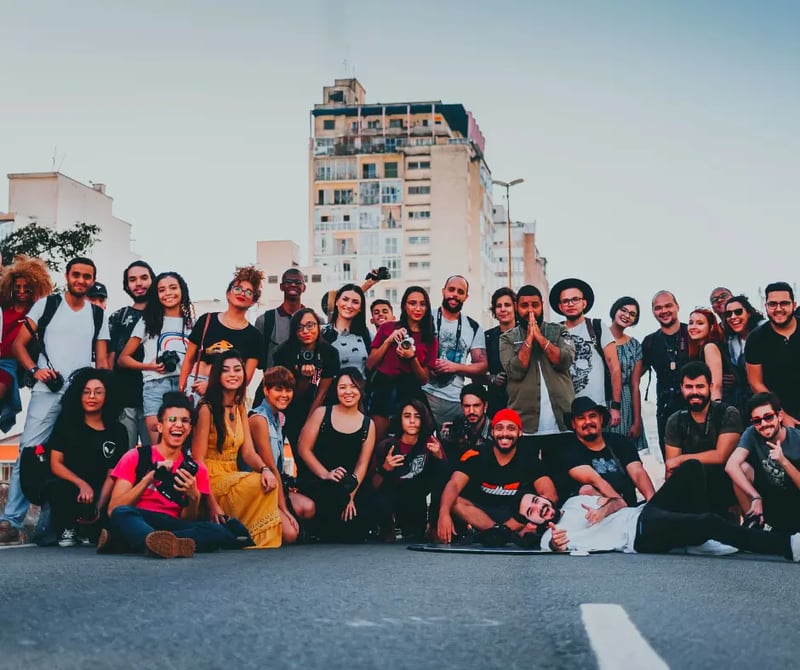
First-time nomads who just quit an office job, people who have been on the road for a decade, freelancers, founders, developers, creators, couples and a lot of solo travelers. If you are not a nomad yet but curious, you are welcome too: the organizer says so plainly in its FAQ. And because the whole week is built around connection, arriving alone is completely normal. You will have a structured reason to talk to someone new every hour of the day.
10 tips for first-timers
1. Arrive a day or two early: informal meetups start before the official program. Arriving early gives you time to settle in and meet people before the intensity ramps up.
2. Clear your work schedule: BNF is not a normal working week, and the organizer says so too. If you have to work, aim for two to four focused hours early in the morning, and do not plan launches or heavy client weeks around it.
3. Prepare a 30-second introduction: you will be asked "so what do you do?" around 200 times. Have a short answer ready: who you are, what you do, and what you hope to get from the week.
4. Use the festival app: sessions, activities and premium events are listed and booked in the app, which ticket holders get access to. Browse it about two weeks before the fest and reserve what you really want, because popular activities sell out.
5. Go to the unconferences: the keynotes are good, but the unconferences are where the useful, honest conversations happen. If there is a topic you care about, pitch your own session.
6. Do not try to do everything: the FOMO is universal. Pick what genuinely interests you and let the rest go. The best moments are often unplanned: a coffee that turns into lunch, a last-minute hike, a late-night chat that runs for hours.
7. Follow up the same day: by the end of the week, names and faces blur. When a conversation matters, connect before you part ways. Later never comes during BNF.
8. Go to at least one evening event, even if you are tired: the evenings are where the fest turns from conference into community. The bonfire, the pool party and even a slightly chaotic karaoke night are what people talk about for years.
9. Talk to the locals: Bansko has a warm community of residents and long-term nomads. Some of the best conversations happen at a family-run mehana outside the official program.
10. Stay longer than the festival: the advice almost every veteran gives and almost every first-timer ignores. After the fest, the town slows down and a quieter community emerges of people who chose to stay. Book your flight out at least a week after the closing day if you can.
How to handle the overwhelm
BNF can feel overwhelming, especially in the first few days. The schedule is relentless, you meet new people constantly, and by midweek many attendees hit a wall. What helps:
- Build in quiet time on purpose: a solo walk, a coffee alone, an afternoon nap. These are what let you show up fully for the rest of the week.
- Miss sessions without guilt: nobody attends everything. The people who enjoy the week most curate it.
- Choose depth over numbers: a few real conversations beat twenty quick ones. If you are in a good conversation, stay in it.
- Protect your sleep: three short nights in a row will catch up with you. Pick your late nights.
If the social intensity gets to you, you are not doing it wrong. Even the most extroverted attendees need to recharge somewhere in the middle of the week.
Sarah Kuhlemann
🛂 Schengen, money and other practicalities
- Schengen: Bulgaria is now a full Schengen member (air and sea borders from March 2024, land borders from January 2025). For non-EU nationals that means the standard 90 days in any rolling 180-day period, and days in Bansko now count toward your shared Schengen allowance. Bansko used to be a classic "step outside Schengen to reset your days" base. Since 2025 it no longer is. If you need to reset a Schengen clock, nearby Serbia, North Macedonia or Türkiye are the non-Schengen options. The coliving in Europe guide explains how to plan longer European stays around the 90/180 rule.
- EU, EEA and Swiss citizens: full free movement, none of the above limits apply.
- Euro: Bulgaria adopted the euro on January 1, 2026, and the lev stopped being legal tender on February 1, 2026. Cards work in most places, but carry some cash for small cafés, markets and taxis.
- SIM and internet: a local SIM from A1, Yettel or Vivacom starts at around €7 for a few GB, and 4G/5G covers the town. The festival does not provide Wi-Fi at its venues, so if you need to work, use a coworking space or your accommodation.
- Taxis: in Bansko, the Taxi Stars app is the easy way to get a car, and taxis wait at the bus station.
- Health: EU citizens can use the EHIC, everyone else should travel with health insurance. Emergency number: 112.
🌍 What to do in Bansko beyond the fest
- Banya hot springs: a short drive from Bansko, and the setting of the festival's pool party.
- Pirin National Park: a UNESCO-listed national park on Bansko's doorstep, with trails from gentle walks to full-day mountain routes.
- The old town: cobbled streets, stone houses and traditional mehanas. Try banitsa, shopska salad and Bulgarian wine.
- Bear sanctuary near Belitsa: about 45 minutes away, a refuge for bears once used as dancing bears.
- Sofia and Rila Monastery: worth a few days before or after, and Rila is an easy detour on the way.
❓ Frequently asked questions
When is Bansko Nomad Fest 2027?
From Sunday, June 20 to Sunday, June 27, 2027, in Bansko, Bulgaria. Industry Day takes place just before the main week.
Is Bansko Nomad Fest worth it?
For most people, yes, especially if you want community rather than a classic conference. The ticket is cheap compared with most nomad events, Bansko is affordable, and the format is built for meeting people. It is less useful if you need a productive work week or only want polished keynotes.
How much does a week at Bansko Nomad Fest cost in total?
Around €555 to €710 for a solo attendee who buys early and books simple accommodation, and about €990 to €1,290 if you buy late and stay somewhere more comfortable. That includes the ticket, seven nights, food, a few paid add-ons and the return trip from Sofia.
Can you work during fest week?
A little. The organizer advises keeping work to a minimum, since activities run from early morning to late evening. If you must work, plan two to four hours early in the day at a coworking space or your accommodation, as the festival venues do not provide Wi-Fi.
Is it okay to go to Bansko Nomad Fest alone?
Yes. Many attendees come solo, and the week is designed around meeting people, from the park events to the unconferences. Joining the festival Telegram group before you arrive and staying central both make it easier.
Do days in Bansko count toward Schengen?
Yes. Bulgaria has been a full Schengen member since January 2025, so for non-EU visitors days in Bansko count toward the 90 days in any 180. It no longer works as a way to reset your Schengen clock.
🎉 See you in Bansko
Bansko Nomad Fest is hard to explain to someone who has not been. It is intense, overwhelming and sometimes chaotic, and for many nomads it is also one of the best weeks of their year. What makes it special is not the keynotes or even the mountains. It is a week with hundreds of people who do not need this lifestyle explained to them.
If you want to go in 2027, buy your ticket in the early-bird window, book a central bed straight after, plan your Schengen days with Bulgaria counted in, and leave room in your calendar to stay on afterwards. Then go with an open schedule and lower expectations than you think you need. The week tends to exceed them anyway.
Sarah Kuhlemann Sarah Kuhlemann