
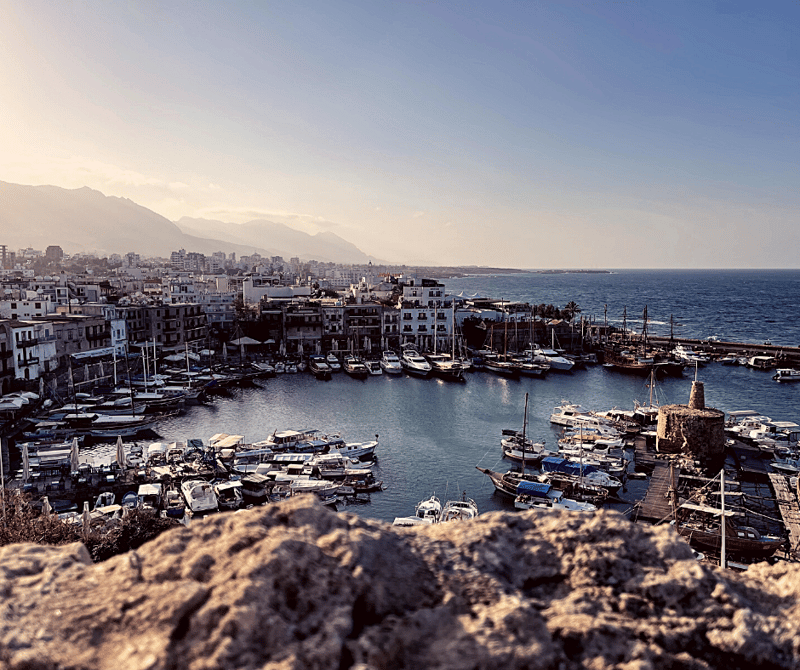
Cyprus sits in an unusual spot on the nomad map. It is in the EU and uses the euro, but it is not in the Schengen Area yet, so its 90 days are counted separately from the rest of Europe. It runs a digital nomad visa, but one with a cap on the number of permits. And it is an island divided in two, which decides where you land, how you cross and which rules apply where.
The nomad life itself happens in four cities: Larnaca for value and the main airport, Paphos for the island's strongest coworking community, Limassol for business and the highest rents, and Nicosia for local life inland. This guide compares them with realistic short-stay costs for 2026 and is upfront about the catches: summer heat, Limassol prices, and a Schengen status that is likely to change.
🌱 Health insurance for Cyprus
Summary
- 🌱 Health insurance for Cyprus
- 🎯 Cyprus at a glance
- 🇨🇾 Entry requirements and the Schengen wrinkle
- ✈️ How to get to Cyprus
- 🗺 Where to base yourself
- 💶 How much does it cost?
- 💻 Cyprus's digital nomad visa: the short version
- 🧑🏻💻 Where to work from
- 👥 Finding the community
- 🧭 One island, two sides
- 🛜 Internet and SIM cards
- 🌤 When to come
- 🚌 Getting around
- 🚧 Safety
- 🎖 Must see
- ❓ Frequently asked questions
- 🎯 Conclusion
🎯 Cyprus at a glance
| 🇪🇺 Basics | EU member, euro (€), not in the Schengen Area yet |
| 🛂 Visa | 90 days in any 180 visa-free for US, UK, Canadian, Australian and many other passports, counted separately from Schengen |
| 💻 Nomad visa | Yes. €3,500 a month net, 1 year renewable to 3, with a cap on permits |
| 💶 Monthly budget | €1,500 in Nicosia or Larnaca to €3,600 in Limassol for a short stay in your own flat |
| 🛜 Internet | Median fixed broadband around 160 Mbps, mobile around 110 Mbps |
| 🌤 Best time | March to June and October to November. July and August are very hot, especially inland |
| 🗺 The division | The government controls the south, and EU law is suspended in the north. Always enter the island through the south |
🇨🇾 Entry requirements and the Schengen wrinkle
Cyprus joined the EU in 2004 but has not yet joined the Schengen Area. For remote workers from outside the EU, that one detail shapes the whole stay:
- EU, EEA and Swiss citizens: no visa, an ID card is enough.
- Visa-exempt nationals (US, UK, Canada, Australia and many more): up to 90 days in any 180-day period in Cyprus, according to the UK travel advice. Because Cyprus is outside Schengen, that allowance runs on its own clock. Days in Cyprus do not use up your Schengen 90/180, and Schengen days do not use up your Cyprus days.
- Passport stamps, not biometrics: the EU's Entry/Exit System runs only in participating Schengen countries. In Cyprus, passports are still stamped by hand.
- Time in the north counts: the Republic of Cyprus adds days spent in the north to your 90-day visa-free total.
- Arrive in the south: the Republic does not consider entry through Ercan airport or the northern seaports legal, as the US travel advisory notes. Fly into Larnaca or Paphos.
- The countdown: the European Commission confirmed in July 2026 that Cyprus is technically ready for Schengen. The final step is a unanimous decision of the Schengen member states in the Council, and it had not been taken by mid-November 2026. Cyprus's president says the incoming Greek Council presidency is aiming for July 1, 2027, as Cyprus Mail reported. Once Cyprus joins, days on the island will count toward the standard Schengen 90/180. If the separate clock is part of your plan, treat it as temporary and check the status before you book.
✈️ How to get to Cyprus
Almost everyone flies. Larnaca (LCA) is the main international airport and Paphos (PFO) the second, both run by Hermes Airports, with budget connections across Europe and links to the Middle East. From North America or Australia, expect at least one connection through a European or Gulf hub. Book into the south only, for the reason in the entry section above.
🗺 Where to base yourself
Larnaca is the value pick and the easiest arrival. The airport is about 5 km from the center, the old town is walkable, and the Finikoudes seafront promenade runs right along it. Rents are well below Limassol and Paphos: Numbeo's November 2026 data puts a one-bedroom in the center at a median of about €900 a month on a long lease. Two old-town coworking spaces anchor a small, friendly remote-work crowd. The community is quieter than in Paphos, but for many the airport and the price settle it.
Paphos has the island's clearest nomad community, built around the Hügge coworking hub in the old town (Ktima). Base yourself in or near the old town rather than on the tourist strip by the harbor. The archaeological park with its Roman mosaics is a UNESCO World Heritage site, and Paphos airport is close by. Rents sit between Larnaca and Limassol, around €1,145 for a central one-bedroom on Numbeo's long-lease median.
Limassol is the business capital: international, corporate and the most expensive city on the island. A central one-bedroom runs at a median of around €1,445 a month long-term, and short stays cost more. Come here if your work, clients or network are here. The coworking market is the most professional on the island, while the nomad scene in the backpack-and-laptop sense is smaller than the city's size suggests.
Nicosia is the inland capital and the most local choice, with the lowest rents of the four (a median of about €700 for a central one-bedroom) and a walled old town split by the Green Line. It is also the hottest city on the island in summer, with no sea to escape to. Good for a winter or spring stay and for anyone who wants Cypriot daily life rather than a coastal bubble.
💶 How much does it cost?
| Per month | Nicosia / Larnaca | Paphos | Limassol |
|---|---|---|---|
| Furnished 1BR, 1 to 3 months | €750–1,300 | €1,000–1,500 | €1,400–2,300 |
| Coworking | €225–280 | €95–195 | €380 (dedicated desk) |
| Food | €350–500 | €350–500 | €400–550 |
| Utilities, if not included | €150–250 | €150–250 | €150–300 |
| Transport and phone | €50–90 | €50–90 | €50–90 |
| Realistic total (own 1BR) | €1,500–2,400 | €1,650–2,550 | €2,400–3,600 |
Cyprus is not a budget base, and Limassol is in a league of its own. Numbeo's November 2026 figures put the median rent for a central one-bedroom at about €1,445 in Limassol, €1,145 in Paphos, €900 in Larnaca and €700 in Nicosia. Those are long-lease numbers from user reports. Furnished stays of one to three months, the way most nomads arrive, cost noticeably more, and the table builds that in.
Utilities are the other line to watch: air conditioning runs hard from June to September, and Numbeo's utility medians already sit at €165 to €200 a month for a small flat. Ask whether bills are included before you sign, and ask how the flat is heated if you come between December and February. Bazaraki, the island's main classifieds site, is the quickest way to check current asking rents in each city.
💻 Cyprus's digital nomad visa: the short version
The Cyprus Digital Nomad Visa is a temporary residence permit for non-EU and non-EEA nationals who work remotely for an employer or clients outside Cyprus. It lasts one year and can be renewed for two more, three years in total. A spouse or partner and children can join for the same period but may not work in Cyprus, according to the Migration Department.
The income bar is €3,500 a month net, after taxes and contributions, plus 20% for a spouse or partner and 15% for each child, shown with six months of bank statements. You enter Cyprus visa-free or on a visa, then apply in person at the Migration Department in Nicosia within three months of arrival. Government fees are €70 for the application and €70 for the permit. The document list also includes a criminal record certificate, medical test results and a stamped rental agreement.
The catch is the cap. The scheme started in 2021 with 100 permits, rose to 500 in 2022, and was doubled to 1,000 a year in October 2025, as Cyprus Mail and local law firms report. The Migration Department's own scheme page still showed the 500 ceiling at its last update, and there is no public count of places left. No closure had been announced by mid-November 2026, but the scheme has paused before once its quota filled, so apply early in the year and confirm availability before you build a plan around it.
The insurance line is specific. The Migration Department's document list asks for a certificate of health insurance covering inpatient and outpatient care and the transportation of remains, known locally as Plan A cover. Permit holders are not covered by GeSY, the public health system, so the private policy is your actual healthcare for the whole stay, not just paperwork.
Good to know: choose Genki Native if you have no access to a national health care system in your home country, and Genki Traveler if you do. Genki can't guarantee that a policy meets Cyprus's permit requirements, so check the wording with the Migration Department before you apply.
Staying 183 days in a year, or 60 days under specific conditions, can make you tax resident in Cyprus, which the guide to digital nomad taxes explains together with the non-dom regime. For the full requirements and how Cyprus compares on the digital nomad visa landscape, including why a net-income bar is higher than it looks, see the overview:

🧑🏻💻 Where to work from
Paphos
- Hügge Coworking: the island's nomad anchor, in the old town. Open around the clock for members, with a rooftop, café and gym, plus a weekly rhythm of rooftop yoga, a Friday bar, beach volleyball and hikes. Day pass €15, week €60, monthly hot desk €150, fixed desk €195, or a €95 community plan for part-time use, all including VAT. If you land in Cyprus knowing nobody, start here.
Larnaca
- OHouse Coworking: a garden coworking with 24/7 access and 400/200 Mbps fiber. Day pass €18, flexible week €75, 10 days €125, flexible month €225, dedicated desk €280. Pet friendly.
- NATIVE Cowork: in the old town at Dimotikis Agoras 20, a short walk from the Finikoudes promenade, with hot desks, private offices and meeting rooms. Its website does not reliably load for automated checks, so confirm current rates with the space directly.
Limassol
- SOHO Office Space: two locations, SOHO Central and SOHO Embassy, with a gym, sauna, rooftop and regular events. Hot desks from €20 a day, dedicated desks from €380 a month.
- The Business Bar: a coworking space in a historic building facing a square in the center, with hot desks and VIP desks or rooms for up to four. Packages via its booking page.
Prices change often, and some spaces quote without VAT (19% in Cyprus), so check current rates before you commit. Most nomads on the island rent a flat and add a coworking membership rather than living in coliving.
👥 Finding the community
- Paphos: the island's real nomad community, and the easiest place to arrive alone. Hügge's calendar of yoga, Friday bars, sport and a monthly First Friday BBQ is where most newcomers meet people.
- Limassol: a large international business crowd rather than a nomad scene. Social life runs through coworking events, with SOHO alone citing a network of more than 3,000 members, and the wider expat circuit.
- Larnaca: small and friendly, centered on the two old-town coworking spaces. Expect familiar faces quickly, not a busy events calendar.
- Nicosia: a university and government city with very little nomad infrastructure. Build a social life through language exchanges, sport and local friends.
- Online: city-based Facebook groups for nomads and expats are where sublets, flat leads and meetups circulate.


🧭 One island, two sides
Cyprus has been divided since 1974. The government of the Republic of Cyprus, the EU member state, controls the south. The north is run by a Turkish Cypriot administration recognized only by Turkey, and the UN-patrolled buffer zone known as the Green Line runs between the two, straight through Nicosia. The whole island is EU territory, but EU law is suspended in the areas not under the government's effective control, under Protocol 10 of Cyprus's accession treaty, as the European Commission explains. What that means in practice:
- Crossing: day trips north are routine. You cross at the official crossing points with your passport, or an ID card for EU citizens. In Nicosia, Ledra Street and Ledra Palace are pedestrian crossings, as the UK travel advice lists.
- Arrival: always enter the island through the south. Arriving through the north counts as illegal entry for the Republic and can mean fines or refusal of entry later.
- Your visa clock: days in the north count toward your 90 days in Cyprus.
- Cars: rental insurance from the south usually does not cover the north. Buy separate cover at the crossing, as the UK safety advice explains.
- Which rules apply: everything in this guide, from the nomad visa to EU roaming, applies in the government-controlled south.
- After Schengen: Cyprus's foreign minister has said joining Schengen will not change who can use the crossing points, according to Cyprus Mail.
🛜 Internet and SIM cards
Home internet is solid rather than spectacular. In Ookla's Speedtest Global Index, Cyprus measured a median of about 160 Mbps on fixed broadband and 110 Mbps on mobile in May 2026, enough for calls and uploads in any city flat with fiber. Coworking spaces run faster lines, such as OHouse's 400 Mbps connection.

Stay connected wherever you go: Get 7 days of free global data and a discounted monthly rate through Pangia Pass. But their best-ever discount won't last, so grab it soon.
An EU SIM works in the government-controlled south at no extra cost under EU roaming rules. Cyta and Epic are the main local operators, with prepaid SIMs at the airport and in shops, and a global eSIM is the easiest option if Cyprus is one stop of several.
🌤 When to come
| J | F | M | A | M | J | J | A | S | O | N | D | |
|---|---|---|---|---|---|---|---|---|---|---|---|---|
| Coast (Larnaca, Limassol, Paphos) | ⛅ | ⛅ | ☀️ | ☀️ | ☀️ | ☀️ | 🥵 | 🥵 | ☀️ | ☀️ | ☀️ | ⛅ |
| Nicosia (inland) | ⛅ | ⛅ | ☀️ | ☀️ | ☀️ | 🥵 | 🥵 | 🥵 | 🥵 | ☀️ | ⛅ | ⛅ |
| Troodos mountains | ❄️ | ❄️ | ⛅ | ⛅ | ☀️ | ☀️ | ☀️ | ☀️ | ☀️ | ⛅ | ⛅ | ❄️ |
☀️ best · ⛅ mixed · 🥵 hot · ❄️ cold or snow
Heat is the honest headline. July is the hottest month, with average highs around 37°C inland and 30 to 33°C on the coasts, and heatwaves can push inland temperatures to around 40°C, as Politis reported from the met office. September is still summer: long-term averages put it at about 29°C at Paphos airport, 31°C at Larnaca and 33.5°C in Nicosia, according to Department of Meteorology figures cited by Cyprus Mail. Paphos and the west coast are the coolest bases, Nicosia the hottest.
For working, the comfortable windows are March to June and October to November. Winters are mild on the coast and cold up in the Troodos mountains. Indoors is the catch: many flats are built for heat, so ask about heating before you book from December to February.
🚌 Getting around
- Buses: public buses run within the cities and between them, with routes and fares on the official Cyprus by Bus site. Monthly city passes cost around €40 to €50.
- Ride-hailing and taxis: Bolt operates alongside licensed taxis.
- Car rental: the realistic option outside the city centers and for the mountains. Cyprus drives on the left.
- No trains: the island has no railway, so buses and cars do all the work.
🚧 Safety
Everyday crime is low, and the US rates Cyprus at its lowest advisory level, exercise normal precautions. The bigger risk is the road: the UK travel advice warns that driving standards are poor and road deaths higher than in the UK. The emergency number is 112.
🎖 Must see
- Nicosia: the walled old town and a walk across the Green Line at Ledra Street.
- Paphos Archaeological Park: UNESCO-listed Roman mosaics and the Tombs of the Kings.
- Kourion: a Greco-Roman theater above the sea, west of Limassol.
- Troodos mountains: hiking, cooler summer air and UNESCO-listed painted Byzantine churches.
- Akamas peninsula: boat trips from Latchi to the Blue Lagoon.
❓ Frequently asked questions
Is Cyprus in the Schengen Area?
Not yet, as of November 2026. Days in Cyprus do not count toward your Schengen 90/180, and Cyprus counts its own 90 days in any 180. The European Commission confirmed Cyprus's technical readiness in July 2026, but the Council decision is still pending, with July 2027 named as a target. Once Cyprus joins, its days will count toward the Schengen total.
Does Cyprus have a digital nomad visa?
Yes. It requires €3,500 a month net, lasts one year and can be renewed to three. You apply in person in Nicosia within three months of arrival. Permits are capped, reported at 1,000 a year since October 2025, so check availability. Health insurance must cover inpatient and outpatient care and the transportation of remains.
How much does it cost to live in Cyprus as a nomad?
For a short stay in your own furnished flat, roughly €1,500 to €2,400 a month in Nicosia or Larnaca, €1,650 to €2,550 in Paphos, and €2,400 to €3,600 in Limassol.
Is Larnaca good for digital nomads?
Yes, if value and flights matter most. Larnaca has the main airport close to the center, lower rents than Paphos or Limassol, and two old-town coworking spaces. The community is smaller than in Paphos.
Where do digital nomads live in Cyprus?
Paphos for the strongest community around the Hügge coworking hub, Larnaca for value, Limassol for business, and Nicosia for local life inland.
Can I visit the north of the island?
Yes. Day crossings at the official crossing points are routine with a passport, or an ID card for EU citizens. Enter the island through the south only, remember that days in the north count toward your 90 days in Cyprus, and buy separate car insurance if you drive across.
🎯 Conclusion
Cyprus works best for a specific kind of nomad: someone who wants EU stability and winter sun, can handle the summer heat or leave for it, and either meets the nomad visa's income bar or is using the island's separate 90 days while they last. It is not cheap, Limassol least of all, and outside Paphos the community is thin.
Pick the city first: Paphos for community, Larnaca for value and flights, Limassol if work brings you there, Nicosia for local life. Then check two things that can change within a year: the Schengen decision and, if you are applying, the visa cap.
Where to travel next? Destinations close to Cyprus.